Structural Drying and Dehumidification in Alhambra, CA
Surfaces dry in a day; framing, plaster and subfloor do not. The drying team sets equipment to the evaporation load of each room and keeps it running until the readings say dry.
(888) 578-6508Get structural drying started in Alhambra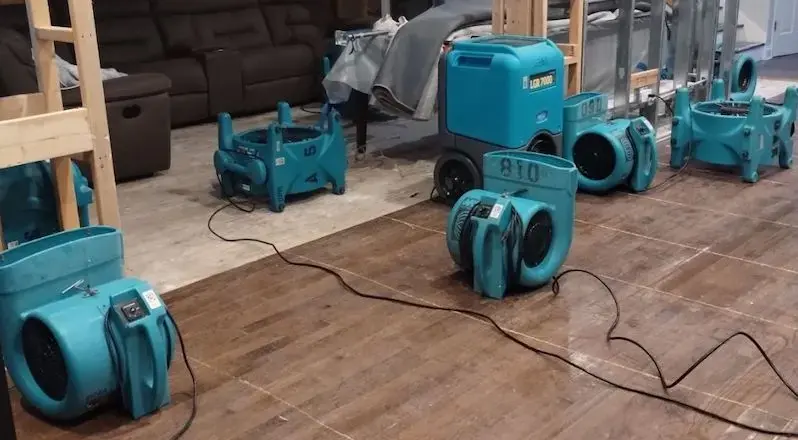
First steps for structural drying in Alhambra
- 1Keep the equipment running
Leave air movers and dehumidifiers on unless there is a safety concern.
- 2Close windows and doors
Keep the drying area closed so dehumidifiers work on a contained space.
- 3Keep paths clear
Leave space around equipment and cords for daily readings.
- 4Call with questions
Call 24/7 if a unit stops or a breaker trips.
What does structural drying and dehumidification cost in Alhambra, CA?
In Alhambra, CA, structural drying typically runs $800 to $6,000, depending on the square footage, the class of water loss, how dense the wet materials are and how many days of equipment the readings require.
Ranges only, never a quote. The category of water, the square footage, the material class and how fast drying started move the number most. Try the water damage cost calculator for a closer planning range.
How structural drying is handled in Alhambra
- 1
Map moisture
Every wet material is measured and recorded before equipment goes down.
- 2
Set equipment
Air movers and LGR or desiccant dehumidifiers are sized to each room.
- 3
Monitor daily
Moisture and psychrometric readings are logged every day.
- 4
Verify dry
Equipment comes out when materials match the dry reference.
Structural drying is the part of a water loss that decides whether the problem is really over. Paint and baseboard can feel dry within a day, while the studs, plates, subfloor and the plaster in an older Alhambra home still hold enough water to cause trouble weeks later. IICRC S500 is the industry drying standard, and it treats drying as something that is measured, not guessed.
How the drying plan is set
- Moisture mapping records every wet wall, floor and ceiling before any equipment goes down
- Class 1 through 4 sets how much equipment a room needs, from a small wet area to dense materials like hardwood and plaster
- Air movers are placed to the evaporation load of each room
- LGR dehumidifiers pull the water back out of the air; desiccant units handle Class 4 materials
Older homes dry differently
Many pre-war Alhambra homes have lath and plaster walls, thick oak floors and raised wood framing. Plaster holds water longer than drywall, and old-growth framing is dense. The drying team uses targeted airflow, wall cavity drying through small openings where needed and patient monitoring instead of tearing out plaster that can be saved. Newer apartment buildings with drywall and slab floors usually dry faster.
- Readings are taken at the same marked points each day
- Psychrometric readings of temperature and humidity show the equipment is working
- The drying goal is within 2 to 4 points of a dry reference material in the same building
- Equipment leaves on the readings, not on a schedule
Documentation for the claim file
The daily log is the proof that drying was done correctly. It holds the moisture map, the psychrometric readings, the equipment placed and removed, and photos taken before any demolition. The EPA indoor air quality pages explain why keeping indoor humidity under control matters after water damage, and the California Department of Insurance covers what documentation a claim typically needs.
Leave the equipment on
Turning off air movers or dehumidifiers at night slows drying and can let humidity climb. The equipment is sized to run continuously until the readings are met.
Covering Alhambra, CA and the west San Gabriel Valley
Alhambra water damage pros handle structural drying across every Alhambra ZIP and the neighboring San Gabriel Valley cities, day or night.
ZIP codes 91801 and 91803, plus Emery Park, Midwick Tract, Bean Tract, Mayfair and the Valley Boulevard corridor, with San Gabriel, San Marino, South Pasadena, Monterey Park and Rosemead next door.
See every neighborhood and ZIP coveredRelated water damage services in Alhambra
Structural Drying and Dehumidification questions in Alhambra
1What is IICRC S500?
It is the industry standard for professional water damage restoration. It covers how water losses are categorized, how drying is set up and how it is verified with measurements.
2How does the drying team know when it is dry?
Readings on the wet materials are compared with a dry reference material in an unaffected part of the same building. The goal is within 2 to 4 points of it.
3Why is the equipment so loud and warm?
Air movers push large volumes of air and LGR dehumidifiers release warm, dry air. That combination is what pulls water out of the structure.
4How long does structural drying take?
A contained Class 1 loss usually dries in three to five days. Hardwood, plaster and multi-layer flooring take longer.
5Can I turn the equipment off at night?
It is best left running. Stopping it slows drying and can let humidity climb back up.
6Is drying documented for insurance?
Yes. The moisture map, daily psychrometric readings and photos form the drying log that goes into the claim file.
Structural Drying and Dehumidification in Alhambra? Call now.
The restoration team extracts the water, dries the structure to the IICRC S500 goal and documents every reading for the claim file.